There are various reasons why universities and other organisations choose to make a switch to a different LMS.
Common ones include:
- Lack of choice around hosting, security and data
- Limited customisation options
- Little or no control over the product / upgrade roadmap
- Difficulty integrating with other systems
- Slow or costly implementation of new functionality
- Inability to support different departments and end user groups
- Poor user experience or engagement
- Rising licensing or per-user costs
From our experience, with Clients who have migrated from other LMS to Moodle with Catalyst, the most common reason for switching was lack of flexibility and control. After the move, our Clients also cited things like greater transparency, full access to their LMS, and ability to choose the level of involvement by their technical partner, as unexpected and valuable add-ons.
Moodle’s flexible business model offers organisations more control over their technical environment and more freedom to evolve it over time. Its open architecture and flexibility mean you’re not locked into a single way of doing things. You have greater choice around what you do, who you work with, and how the platform is hosted, configured, integrated and extended.
Short term commitment for long term benefits.
Despite the ongoing pain points that your team may experience with your current LMS, making a decision to switch to a new LMS is often the greatest mental barrier. It’s understandable that with all the courses, learner data, integrations and change management involved, the idea of LMS migration is often accompanied by a degree of hesitation.
Staying with your existing LMS when it no longer serves all your needs can start to become a sunk-cost fallacy, and not a great strategy for success. If your new LMS will provide greater flexibility, control and long term cost efficiencies, it makes sense to make the move.
What if the migration fails?
The most important choice to make when considering cloud migration is the choice of vendor. You need to make sure you select a vendor who has proven success in this space. Their migration process needs to structured, predictable and well communicated, so your teams knows what to expect at every stage.
Migration process in brief:
Discovery and audit is a critical first step in the process. At Catalyst we take a thorough approach to understanding a Client’s current LMS and how it supports their organisation – what are the course structures, integrations needs, and so on.
This is followed by data migration planning and execution. Course content and user data are carefully mapped and moved across, with checks in place to catch issues before they affect learners.
We then configure and build the LMS environment to match all the requirements. After that, we test, launch and provide training and post-migration support.

Download our latest whitepaper – Why Cloud Migrations Fail and How to Make them Work – which explains common pitfalls, and provides further details on Catalyst IT’s migration framework.
Why universities and enterprise level companies choose to switch to Moodle with Catalyst?
One of the key reasons educators and IT specialists choose Moodle is for it’s unmatched flexibility, which extends beyond a list of features. Learn more here.
Another benefit of moving from another LMS to Moodle, and especially to Moodle with Catalyst, is that none of the functionality you currently use will be lost. Moodle’s modular design means that where a plugin or feature is unique to your current platform, our team can usually easily rebuild or replace it, often working from nothing more than screenshots of how it currently behaves.
That flexibility is one of the clearest advantages of moving to an open source platform like Moodle – you can make it yours and maintain it as suits you. Something you cannot do when moving to a less flexible, proprietary LMS platform.
With a combination of both: established functionality and the flexibility to extend the platform as you wish, you will ensure business and academic continuity, in line with your current as well as your future, changing needs.
Moodle can support different learning models, user groups and organisational structures, while integrations and custom functionality can connect the LMS to the wider technology ecosystem.
Catalyst IT’s deep, technical Moodle expertise dates back almost 30 years, to the very first versions of the Moodle product. Our team are one of the largest contributors to the Moodle project, meaning that you don’t have to compromise. With Catalyst, you can make Moodle truly your own. We have built many custom plugins and tools for our Clients’ Moodle sites, strengthening their EdTech stack and their position to deliver quality teaching and learning experiences.
We have also completed 100s of successful LMS migrations worldwide, and provide scalable hosting and 24/7 Follow the Sun support for some of the largest Moodle sites globally.
There is no matching offer on the LMS market.
Proprietary LMS platforms will never be as adaptable as Moodle with Catalyst, and will never provide you with the same degree of control and freedom to innovate. Some of our Clients have learned this lesson the hard way. We have welcomed back a number of clients who switched to another LMS provider only to come back to Moodle, and to us, later.
With choosing Moodle with Catalyst, you can have both, a more suitable LMS Platform and an easier migration.
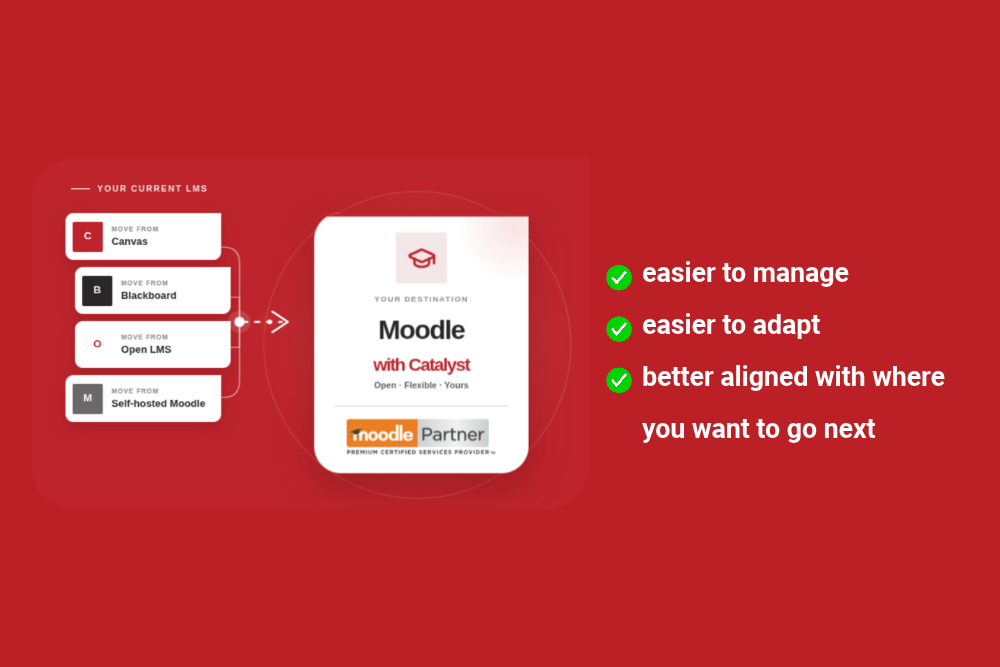
The best LMS migration isn’t necessarily the one where everything looks exactly the same on day one. It is the one that leaves your organisation with a platform that is easier to manage, easier to adapt and better aligned with where you want to go next.
This is why Moodle LMS is an attractive alternative to more restrictive LMS platforms, and is a preferred solution for many larger organisations, including universities, TAFEs, government organisations and enterprise businesses with complex learning environments.
Move to Moodle with Catalyst
So, is switching LMS providers easier than you think? It can be.
The complexity of an LMS migration isn’t determined by the migration alone. It depends on the platform you’re moving to, the quality of planning, the complexity of your existing environment and the experts supporting the transition. A well-planned migration can be structured into manageable stages and the process will not be as painful as imagined.
At Catalyst IT , we understand that every LMS migration is different. That’s why our approach starts with understanding your existing environment, your learning strategy and what you want to achieve; it is never simply about moving data from one platform to another. Our team will serve as your trusted advisor every step of the way.
If your current LMS is becoming a constraint, perhaps it’s time to explore what’s possible with Moodle and with Catalyst.