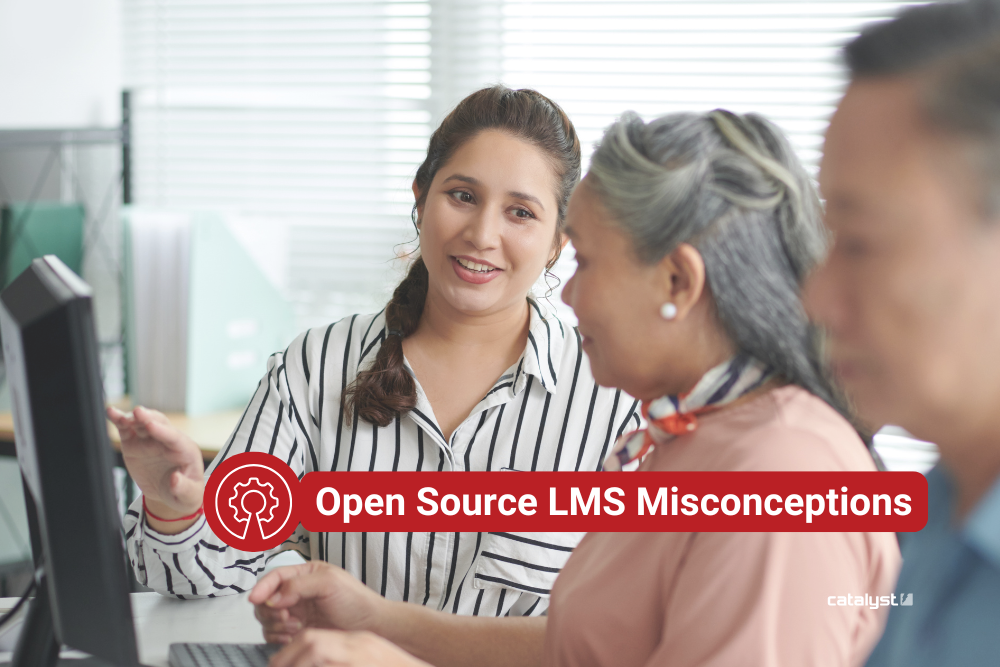
As the LMS market gets more and more saturated, proprietary software providers have started to make false claims about open source technologies in order to win market share. Some of the more recent statements we’ve found are particularly disturbing, and are regarded as marketing tactics to try and win customers.
—
Before we jump into addressing individual open source LMS misconceptions, let’s review the LMS market in Australia and globally for context.
While the foundations of computer assisted training date back to the 1960s, learning management systems for online learning emerged relatively recently – the late 1990s. That’s exactly when (in 1998) the very first open source LMS – Moodle – was created in Australia by Martin Dougiamas.
Moodle stands for Modular Object-Oriented Dynamic Learning Environment and it was released to the public in 2002, with an official partnership program launching in 2004. Due to rapidly increasing demand for online delivery modes, many proprietary LMS companies popped up soon after, and there are known to be over 1,000 LMS solutions today.
As one of the pioneers in the eLearning industry, Moodle still leads the way and maintains its position in the top 5 most used LMS around the world and in Australia.
Open source products such as Moodle are largely preferred by enterprise level organisations and government agencies for their flexibility and, more importantly, for offering business continuity.
Business continuity is one of open source software’s most important benefits and is possible because:
- you are not stuck with proprietary vendor roadmaps
- you can easily modify the code and build your own extensions – customisation options and freedom to innovate is infinite
- you can integrate your open source LMS easily with other software
- if a proprietary LMS provider goes out of business, it will have a direct and significant impact on their clients; this is not the case with open source software which can continue to be supported by other vendors and the community of users that use it
However, as the LMS market gets more and more saturated, proprietary software providers are making false claims about open source technologies to win new customers. These claims are often unfounded and seek to scare new buyers away from open source options. We describe and challenge some of these statements below.
Misconception: Open source software requires in-house hosting and migration management.
Reality:
This statement is wrong! There are plenty of trusted vendors who provide world class Cloud hosting and 24/7 support for open source software.
Misconception: Open source product is a one size fits all solution.
Reality:
This statement is completely misleading and as with the hosting statement, is a pure marketing tactic . The reality and the beauty of open source code is that it’s open for all to make their own. You can customise it to your organisation’s own needs, build upon it, and integrate with anything you like.
Those who say that open source is one size fits all, clearly haven’t done their homework and do not understand open source software’s benefits.
Misconception: Scalability issues as user number grows.
Reality:
Any software with increasing users needs the right mix of infrastructure resources and technical input to remain performant.
Large organisations usually use certified partners / expert open source service providers to support their open source software (OSS) instances. Companies such as Catalyst IT – global open source software experts – offer Cloud hosting environments for their clients that are fully optimised, automated and scalable; supporting hundreds of thousands of users for universities, government agencies and corporations, without adding extra burden on admin teams.
Misconception: Limited file type support.
Reality:
Moodle LMS supports all file types used in the elearning industry.
Misconception: Limited integrations.
Reality:
There are no limitations for open source software integrations. Integration options are limitless.
Also read: Third party systems integration: challenges and opportunities.
Misconception: It’s free.
Reality:
It is free to access but not to operate and service – just like a car needs fuel and a mechanic.
Is it cost efficient (and cost flexible)? Yes, we think it is when compared to the market. The word ‘free’ stands more for the freedoms that OS offers, not necessarily the cost.
Do note: While anyone can download Moodle LMS for free, and modify the software (the source code) as they please – it can be best to leave this to the experts, especially for large, complex organisations that require high levels of customisation, Cloud hosting and management, and ongoing expert advice.
OSS is more cost effective in the long run than proprietary solutions. Learn more below:
Supercharge your business: why it pays to be open.
In Open Source software, ‘free’ stands for freedom, not price.
What’s holding us back from being ‘open’? Why OS and business resilience go hand in hand.
Misconception: OSS management is expensive as it comes with many hidden costs.
Reality:
Commercial off-the-shelf solutions offer much less return on investment as they are inflexible with their pricing and inclusions. You are always tied to proprietary vendors’ roadmaps and business models while open source software pricing is generally based on resource usage rather than strict per-user licensing.
In addition, you can deliver on your own roadmap for enhancements (such as customisations and development of new features) that works for your timelines and budget. In most cases, you can also omit / remove unnecessary features as required to save costs.
If you are dealing with a trusted certified service provider for open source software, like Catalyst IT, then you get transparency in pricing and ongoing personalised advice and support.
Misconception: There is no dedicated support for OSS.
Reality:
Some of the misconceptions we addressed above already prove this statement wrong. Again, for widely used open source software such as Moodle LMS, Drupal, WordPress, there are many service providers who offer development services and ongoing support. You are never alone.
For smaller, simpler Moodle LMS instances you can rely on knowledge libraries and community forums, or talk to larger organisations (who work with professional Moodle service providers) at Moodle events. For larger instances, you have a network of certified partners you can trust.
The Certified Moodle Partner network is a classic example of the depth and range of consultants and development companies that you can engage with. From custom development to Cloud hosting and Managed Services, they offer everything you need to manage, scale and support your site.
Misconception: OSS is bad quality / outdated.
Reality:
Just because there are various open source software products that exist that are ‘abandoned’ i.e. not maintained or used much, it’s easy for competing proprietary companies to generalise their statements and say ‘open source is all bad’.
Open source software that’s widely used however (such as Moodle LMS, Drupal, WordPress and BigBlueButton), is of excellent quality and offers long term benefits – faster speed of innovation and cost efficiencies – that no proprietary software will match. This is because, overtime, open projects are used and improved upon by more and more people, and due to the vast level of perspectives and input can only move forwards and never backwards.
“How we ask the question of quality is important,” notes Brendan Heywood, Catalyst’s Solutions Architect.
“If you ask broadly about the average quality of all OS code, you may not be that impressed with the answer. Instead, ask this: “of the open source software that we use, what is of good quality?” Your answer to that will be very different!” Learn more here.
Moodle LMS, for example, is known for it’s excellent eAssessment, Quiz and Assignment features that even the big players such as Canvas have not yet matched, and continue to score low on these attributes. Again, this is largely due to the growing community of enterprise level Moodle LMS users who contribute to feature improvements overtime.
Misconception: Open Source LMS offers limited analytics.
Reality:
Open source products such as Moodle LMS offer excellent in-built analytics. For granular, customisable and flexible analytics, Moodle is difficult to beat.
In Moodle LMS, educators can:
- Get predictions with machine learning algorithms
- View insights and predictions, such as selecting insights per course with the “Students at risk of dropping out” model
- View previous evaluation logs, such as learning curve graphs and TensorBoard logs
- Edit models by modifying the list of indicators or the time-splitting method (previous predictions will be deleted when a model is modified)
There are also over 30 useful learning analytics plugins, which can be downloaded directly from the Moodle plugins directory. Learn more below:
Moodle Learning Analytics API: https://moodledev.io/docs/5.2/apis/subsystems/analytics
Moodle analytics plugin directory: https://moodle.org/plugins/index.php/?q=analytics
You may also like:
Moodle Analytics and Reporting for student success.
Getting access to your data in Moodle
In conclusion:
Today, there are more than 100 certified Moodle Partners worldwide, and over 500 million users who continue to use Moodle LMS in different ways, contributing to its ongoing innovation.
Testament to Moodle’s ongoing commercial success, Moodle HQ launched Moodle Branded Mobile App (exclusive to Moodle Partner clients) in 2016 and its corporate learning product – Moodle Workplace in 2019 – a premium LMS product which offers advanced features such as multi-tenancy and course catalogue. Learn more here.
The open source nature of Moodle is the major contributor to the company’s, as well as its partners’ and clients’ success and business continuity.
It is easy to fall for the shiny packaging of proprietary providers, however, our call to action is simple – do your research and explore both sides of the argument before you get locked into any contracts.
Be open to the possibility of owning your digital future, rather than following potentially misleading perceptions that are driven by market share goals alone.
If you feel you don’t clearly understand open source, how it works and what long term benefits it can offer to your organisation, talk to an open source expert, weigh-up your insights and make a decision that’s right for you.
Established in 1997, Catalyst now has over 350 specialists globally, providing custom open source software solutions which help our clients achieve their business goals. Our 24/7 Follow the Sun support and well established partnerships with the world’s leading open source software brands make us a trusted provider for leading universities, Government bodies and major organisations in the not-for profit and commercial sectors. Catalyst IT Australia are ISO27001 certified.