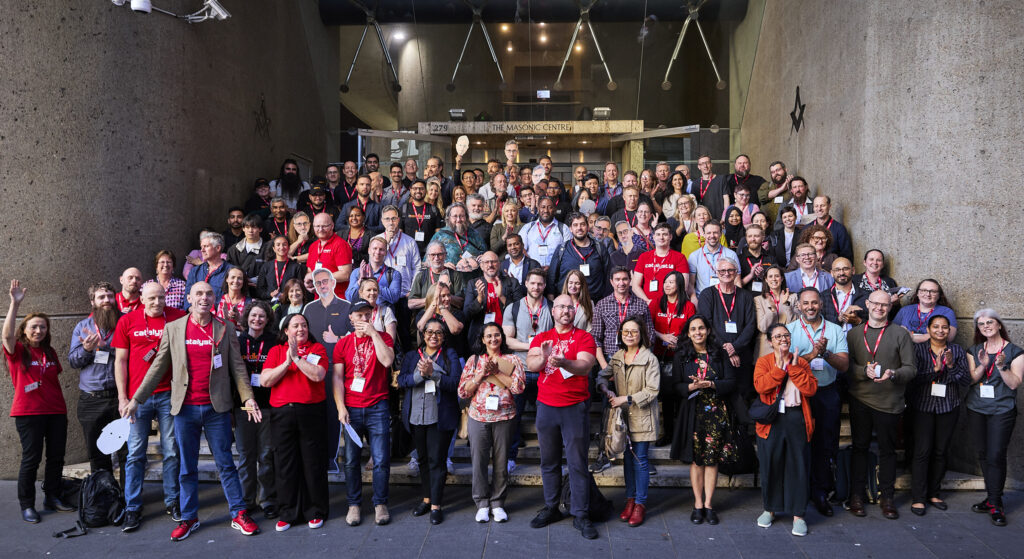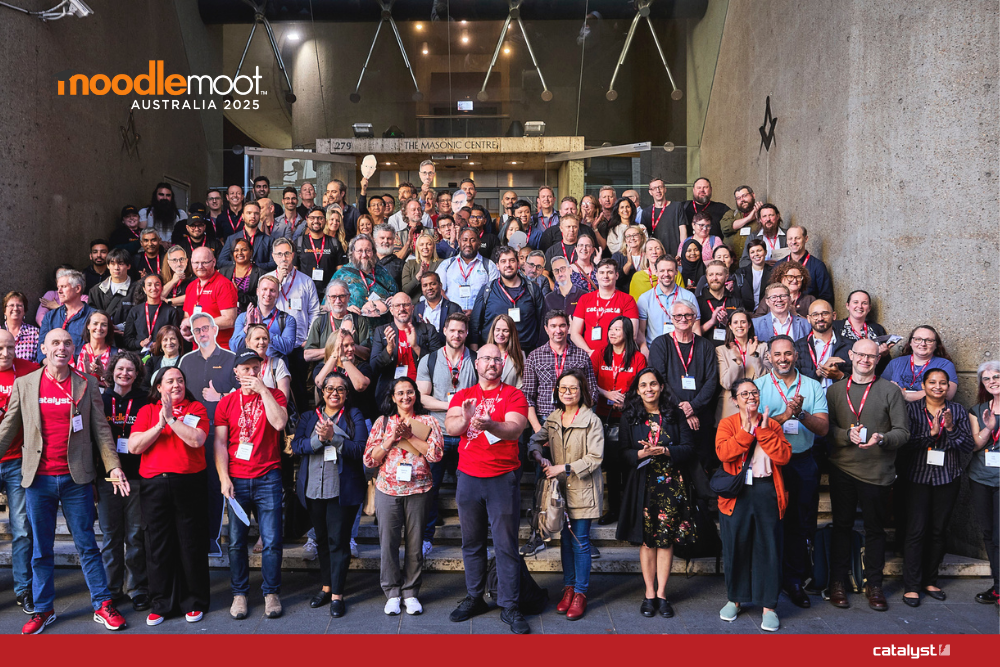
MoodleMoot Australia was a great success. It brought together e-learning and Moodle enthusiasts from various industries – many new connections have been created, Moodle use cases discovered and innovative ideas shared.
“Every day I learn about a different use case for Moodle,” said Marie Achour, Moodle’s Chief Product Officer. “This makes a Product Manager’s role very challenging, yet very exciting.”
What should an LMS look like in 2030?
Having heard from 28 Speakers over the two days, unpacking many Moodle case studies and product tips, one of the concluding questions of the conference was: what do we expect an LMS to look like in 2030?
While we don’t have a definitive answer, our Panelists – Ryan Elwell of ACT Directorate, Alistair Spark of University College London (UCL), Diana Adorno, Product Designer at Moodle, and Brendan Heywood, Solutions Architect at Catalyst IT Australia – had some ideas.
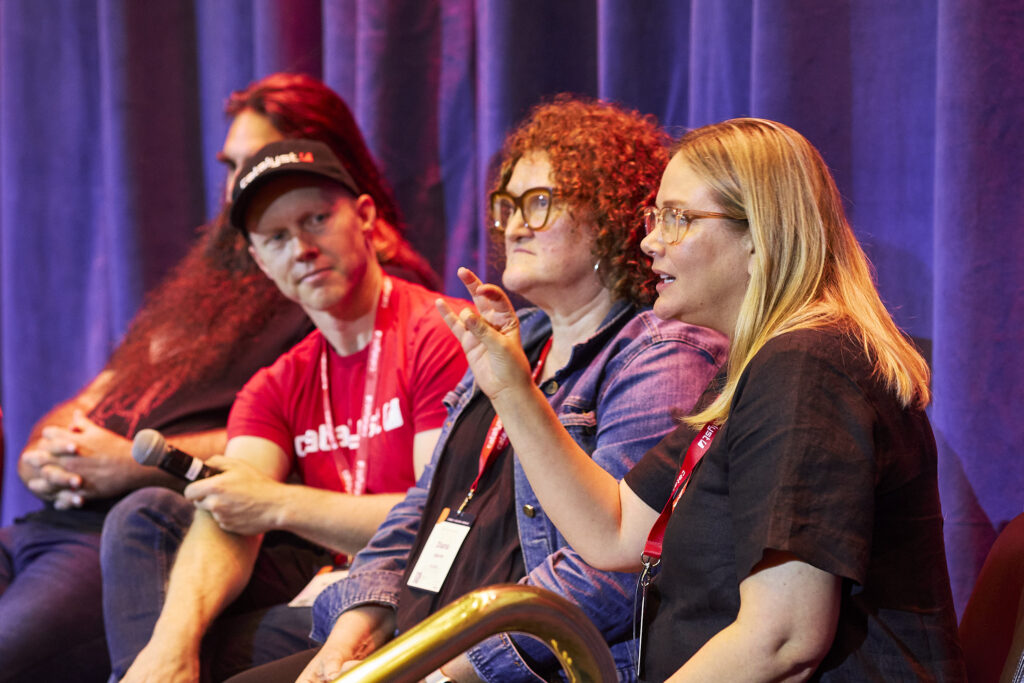
“What I see winning is ‘playing nice’ regardless of the technology that’s being used [by an organisation],” said Ryan. “It is critical.”
“Especially as we continue moving down the AI path, there are more and more companies, more new technologies, with many more ‘new bells n whistles’ and so on. So whenever you are entering into a new ecosystem, you need to ensure it is flexible.”
Ryan highlighted the importance of leaving room to incorporate “things that are more traditional” into digital ecosystems, and making integrations easy.
“Being trapped in an ecosystem can inhibit success. Successful tech has to work nicely with other tech because there is no one size fits all.”

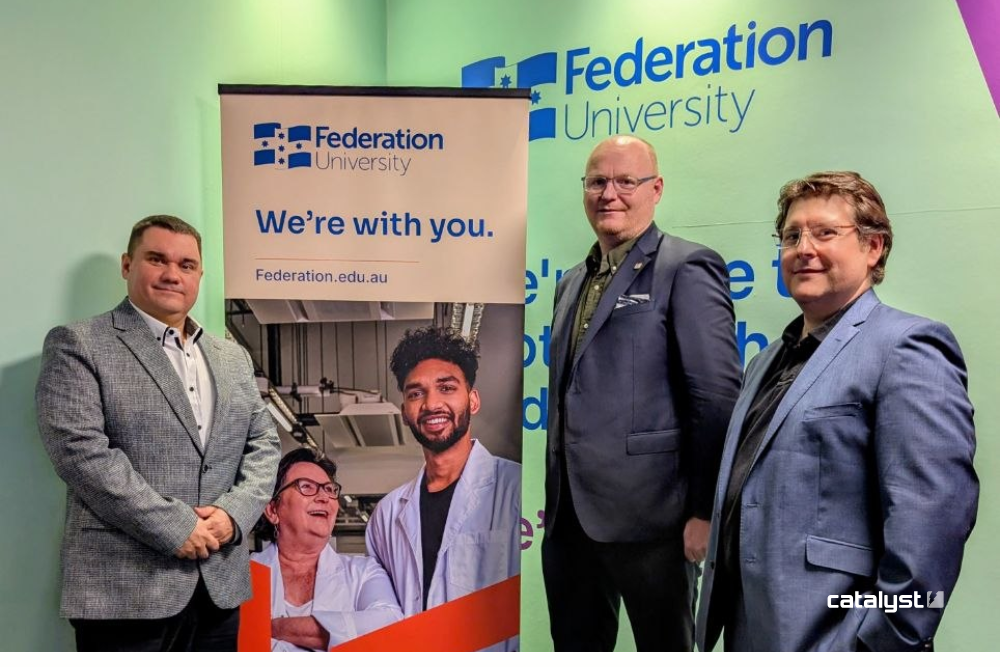
Above (left to right): Ryan Elwell, ACT Education Directorate; Alistair Spark, University College London; Brendan Heywood, Catalyst IT Australia; Diana Adorno, Moodle HQ; Marie Achour, Moodle HQ.
Designing an LMS for a billion people.
Diana Adorno gave us some food for thought with the ‘design for two’ theory.
“What we do see is fragmentation of both teaching and learning, so the question is how do we design for a billion people?”
“When you think of ‘design for one’ you think about yourself, but if you start thinking about the ‘design for two’, that’s already an important shift!”
“To make it work you have to think about extremes – two different extremes will help inform the middle.”
“Storytelling is important – listen and look behind what people are saying. Consider extremes, people’s motivations and individual abilities – what they are actually able to do, how they learn, and what does it all mean for education providers.”
Innovation in EdTech.
When it comes to innovation, our Panelists agreed that it’s not always the ‘iPhone of things’. Smaller improvements often take as long as some of the bigger projects, and their positive impact is as significant.
The audience agreed that curiosity and collaboration are the key ingredients for innovation. Connecting with others, asking questions, exchanging ideas – this is how some of the most successful Moodle stories we know came about.
Bringing technologists, engineers, designers and users together, speaking their language and making them feel heard, delivers better results and more importantly, creates trust among teams. Creating a safe space allows for productive conversations to continue, and for better solutions to be produced.
“A lot of people are worried about not having the answers, and acknowledging this fact,” says Ryan. “Effective communication, connection and honesty are more important than ever.”
In addition, there is a lot of anxiety around AI.
“AI is not going to take your job,” says Ryan. “And if it does, you have seven, you can probably give up one or two.”
This leads us to the next point – AI – which was heavily preset in conversations at MoodleMoot Australia 2025, as it should be.
AI in EdTech (or the AI Anxiety).
“AI is said to be the magical solution to deliver personalised experiences,” said Alistair Spark, Principal Analyst Developer at UCL. “But the problem is this approach is not considerate of the role of a teacher and other factors. What students want vs consistency of academic experience is a balancing act.”
Our audiences did not shy away from being honest, confirming that “it’s all up in the air” when it comes to AI in their organisation, and that the anxiety is real.
While developers and people in technical roles seem to be more excited about it than those in less technical professions, they too are very understanding of the implications.
To the question “how much is AI creating noise in your day to day work?, Brendan Heywood, Catalyst IT Australia’s Solutions Architect and Staff Engineer, says “it is everywhere!”
“For things like refactoring code, AI is great. However, on the other side of the equation is scrolling through slop, which is not useful at all. You can’t just introduce it, you have to understand how you bring value with it.”
Some of the key takeaways around creating value with AI that we took away from MootAU25 include:
- AI can help you shift your time from low to high value tasks
- Focus AI on the slow, low value creation tasks (see Ryan’s Speedometer vs Pesometer theory; measuring time in quality, not quantity)
- See time saved as time generated – think how you will use it to add most value – is it providing better, personalised feedback on assessments to individual students, helping them succeed? or personalising questions to a particular class, investing in a more inclusive form of content development?
- Students have AI anxiety also – students are scared of being accused of misuse of AI and “cheating”
- Be human-centric, develop clarity, trust and connection with your learners
- Personalisation is important in today’s education delivery but AI, while it can provide some assistance, is not the solution for personalisation
- Institutional knowledge of AI and individual knowledge of AI are very different and there is a gap between the two – while organisations like a university are complex, and there are many aspects that go into improving its operations, a well designed, user-centric LMS can help bridge that gap
- See AI as an opportunity
- Be transparent – transparency is also an opportunity
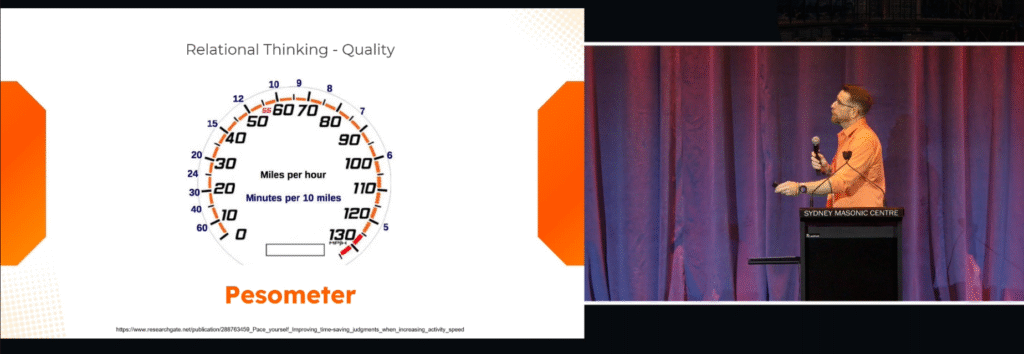
Above: Ryan encouraged the audience to measure time in quality, not quantity; and to think of 10 mile an hour, slow moving tasks when looking where to apply AI.
From hot topics to product updates, to ‘how to’, technical presentations and hands on workshops, we walk away from MoodleMoot Australia 2025 feeling energised. We are inspired to connect with others in the ever growing Moodle community, to discover new possibilities and to set the stage for future EdTech innovations in our (and our client) companies.
Built to be extended, Moodle offers endless possibilities for education providers, Government organisations, as well as Health, Not-for-profit and commercial sectors.
If you would like to share your Moodle success story at one of our future events, email [email protected]
Thanks to all our attendees, speakers, sponsors, the Moodle HQ team, and our team here at Catalyst for another successful Moot! See you at the next one!